
Artificial intelligence, autonomous vehicles, intelligent robots and the energy systems of the future are no longer confined to science fiction. They are rapidly developing fields of research whose results are having an increasingly significant impact on industry, transport and everyday life.
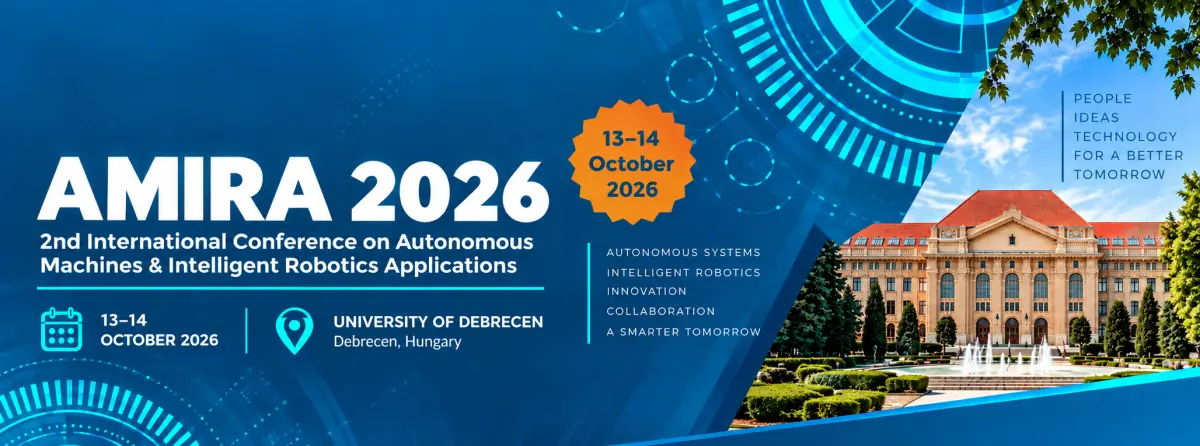
Organised by the Faculty of Engineering at the University of Debrecen and the IEEE Industrial Electronics Society, the 2nd International Conference on Autonomous Machines and Intelligent Robotics Applications (AMIRA 2026)brings together representatives of the international research community and industry. Its six keynote presentations offer insights into developments that could shape the engineering landscape over the coming decades.
Could Robots Pave the Way for Human Exploration of the Moon?
One of the conference's most fascinating topics is presented by Professor Yasuharu Kunii of Chuo University, Japan. His research focuses on intelligent robot swarms: groups of robots capable of cooperating, making autonomous decisions and performing tasks in unfamiliar environments.
The long-term ambition is particularly bold: to develop technologies by 2050 that would enable robots to work together in preparing the construction of lunar bases.
However, this research has applications far beyond space exploration. Cooperating autonomous robots could also assist with disaster response on Earth, explore hazardous environments and inspect large-scale industrial facilities.
When Will We Be Able to Leave the Driving to Our Cars?
Professor László Palkovics presents recent Hungarian research developments in autonomous vehicles. His presentation focuses on two vehicles developed for Level 4 autonomous operation and the control solutions supporting their performance.
A distinctive feature of the research is that the vehicles use not only information from their own sensors but also data provided by a cloud-based traffic management system. The aim is to enable safe, stable and energy-efficient autonomous driving.
The presentation also offers insights from tests conducted at the ZalaZONE automotive proving ground and in real urban traffic environments.
How Is a BMW Factory Built in the Virtual World?
Hans-Peter Kemser, President and CEO of BMW Manufacturing Hungary Kft. and head of the BMW plant in Debrecen, offers a behind-the-scenes look at the future of automotive manufacturing.
His presentation, Production of the Future – BMW iFACTORY, focuses on industrial applications of digital twins, virtual production planning and virtual reality.
What does this mean in practice? The operations of a modern automotive factory can be modelled and tested in detail in a digital environment before production processes begin in the physical world. This allows engineers to examine how production lines will operate, identify potential problems in advance and develop more efficient solutions.
For audiences in Debrecen, it is particularly interesting to see how these technologies are being applied at the BMW plant operating in the city.
When Artificial Intelligence Learns from Its Own Experience
How can a machine be taught not merely to follow predefined instructions but to make increasingly better decisions based on experience?
Professor Radu-Emil Precup of Politehnica University Timișoara explores this question through the engineering applications of reinforcement learning.
The underlying principle is that intelligent systems can improve their performance by learning from feedback. This approach could open up new possibilities for controlling transport systems, industrial machinery and automated equipment.
One of the most important challenges, however, remains safety: how can machines learn while continuing to operate reliably and predictably?
What Will the Energy Supply of the Future Look Like?
As electric vehicles, renewable energy sources and energy storage systems become more widespread, distributing energy efficiently is becoming an increasingly complex engineering challenge.
Professor Pavol Bauer of Delft University of Technology presents the opportunities offered by so-called Energy Hubsystems. These intelligent energy hubs can connect different energy sources, storage systems and consumers, helping to create more flexible and sustainable energy supplies.
In the energy systems of the future, the key question will not only be where energy comes from, but also how it can be used as effectively as possible.
What Will Power the Intelligent Robots of Tomorrow?
The development of robots and electric vehicles requires not only increasingly sophisticated artificial intelligence but also advanced power conversion technologies.
Associate Professor Marek Pástor of the Technical University of Košice presents high-efficiency power electronics solutions that could enable smaller, faster and more energy-efficient systems.
His research includes gallium nitride-based semiconductors and the control of intelligent systems connecting multiple energy sources and consumers. These developments could play an important role in autonomous robotics, electric mobility and the operation of future industrial equipment.
The Engineering Challenges of Tomorrow – Beyond the Keynote Presentations
In addition to the six keynote presentations, AMIRA 2026 showcases a wide range of further research results.
More than 40 scientific papers were submitted to the conference, of which 20 presentations were selected for the technical programme. Participants will have the opportunity to discover research conducted by scientists from several continents.
Topics include mobile robot navigation, human–robot collaboration, intelligent transport, digital twin applications, AI-assisted manufacturing, process monitoring in 3D printing and the development of service robots.
The programme also addresses practical challenges such as communication between automated vehicles and pedestrians, the use of artificial intelligence in animal care, and the role of robots in supporting ageing societies.
On 14 October, conference participants will also have the opportunity to visit the University of Debrecen's modern Vehicle Laboratory, where education and research come together through the latest developments in automotive engineering, mechatronics and robotics.
Inspiration for the Engineers of Tomorrow
AMIRA 2026 offers valuable opportunities not only for researchers and industry professionals but also for students and doctoral candidates at the University of Debrecen. They can gain first-hand insights into the technologies and research directions that may shape their own future careers.
The conference provides a platform for exploring international scientific achievements, establishing new professional connections and discovering how university research and industrial innovation come together.
The technologies of the future are not necessarily decades away – researchers and engineers are already working on many of them today. On 13–14 October, Debrecen offers a glimpse into these exciting developments.
AMIRA 2026 – 2nd International Conference on Autonomous Machines and Intelligent Robotics Applications
Date: 13–14 October 2026
Venue: Faculty of Engineering, University of Debrecen, 2–4 Ótemető Street, Debrecen, Hungary
Further information: https://eng.unideb.hu/en/amira-2026
Detailed programme: https://eng.unideb.hu/sites/default/files/2026-10/AMIRA_2026_Preliminary%20Programme_2.pdf
Cs.K.